This
room provides the visitor with a map that shows the location os the
different ethnic groups surrounding Sucre (Yamparas, Llameros, Jalq’as,
Ch’utas, Tarabucos y Katus) and describes their characteristics and
relationships.
Here, too, the aqsu, or feminine article of
clothing, is introduced and is one of the principal pieces to which the
museum is dedicated, both in its present form and its transformation
throughout history. In colonial and pre-colonial times, the aqsu,
formed from two woven pieces wider than currently used, were wrapped
around women as clothing. Probably during the 19th Century, the
aqsu, in southern Bolivia, turned into a much narrower piece of
clothing that is now used more like a wrap attached at the shoulder and
worn over an “Almilla”, which directly covers the female body.
The shrinking of the aqsu has allowed the development of extraordinary
designs which define the ethnic origin of the women who wear them. The
aqsu and its development constitute an important theme in the ASUR
museum.
|
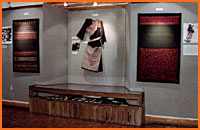
Photographs
illustrate the different artisan activities of the ASUR Foundation:
training of children, embroideries, weavings, and male tapestries, and
women’s traditional looms that have been used for more than 3,000 years. |