|

|
        |
|
 |
Textiles |
|
|
|
|
|
Textile Art of the Jalq'a Y Tarabuco (South Central Bolivia)
For
four thousand years, textiles have been one of the most complex and
artistic expressions to develop in the region of the Andes.
Clothing, and in particular woven articles of clothing, attained a
level of true communicative expression through which communities
depicted their identities and constructed their differences.
The
characteristic features of each group’s distinctive style, besides
their undeniable beauty, also possessed, in general, a feeling and a
precise meaning. It is possible to say, therefore, that Andean textiles
can be "read" like a text and that they speak of certain determined
thoughts and a particular world vision.
This
art survives with great difficulty given the current circumstances of
indigenous societies. In the South-central of Bolivia, however,
two groups, the Jalq'a and Tarabuco, which today speak Quechua, have
been able to maintain their traditional textiles until the present
day. Based on these practices that are still alive today, the
Program carried out by the Foundation for Anthropological Investigation
and Ethnic Development, ASUR, has encouraged resurgence in interest in
the textile arts. In addition to creating an additional source of
income in this highly impoverished area, the production of textiles for
sale has also brought about a spiritual phenomena by fomenting an
appreciation of local culture and by continuing the search for new
meaning and artistic expression. |
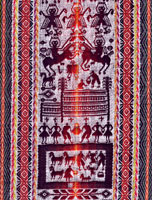
The
textiles of both regions today have achieved exceptional levels of
quality allowing them to be considered not only handcrafts but as works
of art part of a greater universal patrimony.
The Jalq'a
>
The Tarabuco >
|
|
|
| |
Techniques and weaving processes
The
quality of the textiles depends on the weaver’s skill and mental
conceptualization since many of the instruments used are simple and
rudimentary. The vertical loom is of pre-Columbian origin and has
not changed through the centuries allowing, nevertheless, the weaver to
develop different techniques. In reference to raw
materials, natural wool is utilized: sheep wool and cotton in the
case of Tarabuco textiles and sheep and alpaca wool in the Jalq'a
textiles.
The act of learning begins
the moment a little girl, strapped to her mother’s back, can watch her
mother weaving and can observe the handling of the threads and
formation of the figures. The first practice with yarn begins
between ages five and six and continues until a certain level of skill
is achieved. The ASUR foundation has organized several years of
training courses in traditional textiles where young and older girls
can learn from experts, or ajllas, the skill and secrets of quality.
Later they begin weaving small pieces before finally adventuring on to
weave the more complicated aqsu. |
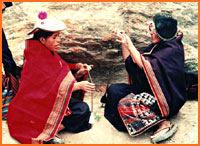
The
technique of the pallay (weaving with designs) requires acute visual
concentration, and for this reason a weaver cannot weave more than five
hours a day, alternating the activity of weaving with other domestic
activities. It is astonishing to be able to observe the combining of
threads in the formation of the figures that are present in the mind of
the artist. The designs created have no previous model,
each textile piece being a new and unique valuable work of indigenous
art. |
| |
|
| |
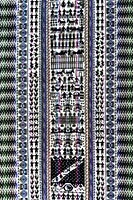
Tarabuco aqsu design The
Tarabuco designs are inscribed onto a more or less elongated rectangle
that combines sheep’s wool and cotton. Inside this rectangle,
through the disposition of form and color, a distinctive space is
recreated displaying clear areas of segmentation, of symmetry, order,
and the impression of self-control.
The Tarabuco recreate an
ordered, perceptible, and luminous world. The abstract figures and
complimentary designs that appear are derived from the styles that
decorated the aqsus of their ancestors.
Iconic figures, however,
are more notable in contemporary Tarabuco designs, because they appear
more dynamic. The weavings from Tarabuco have acquired a new
appeal: a fascination with the miniature executed with great care and
delicacy. Horses, llamas, birds, daily scenes, local people,
comprise the theme now appearing in the banded segments. In the
words of the weavers themselves: “We weave what we see”. Everything
that surrounds man or is object of his perception is properly
highlighted by textures, contrasts, and skillful execution.
|
 |
| |
|
| |
Jalq’a aqsu design As
seen in the case of the Tarabuco weavings, the Jalq’a aqsu is formed in
rectangles, although less elongated. The space is recreated using a
medium of sheep and alpaca wool and most often convey one continuous
background extending without visible articulations or banding and
perceived as a vast continuous space. There is no intention
toward symmetry nor do they propose an ordered axis but rather the
figures fill the space chaotically.
The central figures
populating the Jalq’a textiles are animals known commonly as khurus, or
invincible and savage beasts. The animals represented (horses,
bulls, birds, lions) are based in reality but are uniquely represented
in anatomically impossible ways. The imaginary animals depicted (birds
with four feet, winged mammals, and humpbacked beasts with disfigured
heads) are evoked with exquisite forms and frequently with great
detail, like teeth, for example, something impossible to find in other
Andean textiles.
|

The
world evoked by Jalq’a animals is impossible to envision or even
perceive of directly and is not governed by society’s laws or even
those in nature recognized by man. It refers to a dark place, inhabited
by the khurus, and is the dominion of an underworld diety known as the
saxra and the Jalq’a have chosen this world to define their identity.
|
| |
|
| home
| asur | museum
| shop | textiles
| contact |
|
|
 |
|
|