The Jalq'a
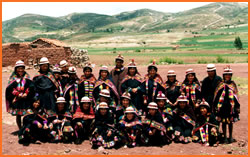
This
ethnic group bridges the border between the provinces of Chayanta
(Department of Potosí) and Oropeza (Department of Chuquisaca). The
population is close to 20,000 people living in low Andean plateaus and
valleys, cultivating potatoes, wheat, barley, some quinoa, maize, peas,
beans, squash, green vegetables and a few fruit trees in the lowest
areas. Small family herds are comprised of sheep and goats, along with
some oxen and donkeys. |
With
the Agrarian Reform of 1952, the Jalq’a were organized in ex–hacienda
communities and some the original ayllus (basic political and social
units based on pre-Inca and Incan organizational structures), such as
Qhara Qhara, Moro Moro (present-day Ravelo) and Quila Quila cantons.
Unlike the Northern Potosí ethnic groups, the Jalq’a do not have a
single, centralized social and political organization for the whole
group. Their unity is reaffirmed in the name Jalq’a, by which they
distinguish themselves from other neighboring groups such as those they
call Llameros, Tarabucos, Ch’utas (in the surroundings of Sucre) and
Katus (from the Tacobamba region).
|
The Tarabuco
Different
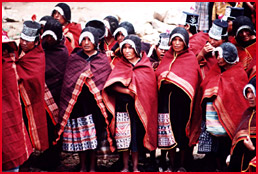
communities surrounding the town of Tarabuco appear today as a
homogeneous culture. They speak the same language, Quechua, they
celebrate common festivals and rites, such as the well–known phujllay
ritual, and above all they wear characteristic clothing, which allows
them to be recognized by outsiders as “Tarabuqueños”.
However,
it was not always this way. When the Spanish reached this region they
found it populated by different ethnic groups from very distant places.
It should be remembered that Tarabuco was
situated on the former Inca border with cultural groups lying farther
east. To guard this border from constant invasions, especially by the
Chiriguanos, the Inca moved warriors from several different provinces
into this area. Very little research has been conducted on this
period, but at some point the descendants of these different groups
began to adopt similar customs and dress which, in spite of minor
differences in the design of certain garments, gave them a common
appearance. |
In
spite of this unity, Tarabuqueños do not themselves have a name for all
those communities that persist in wearing a montera -a sort of
Spanish-style helmet-, nor do they possess collective forms of
organization that might indicate a single origin for them all.
Even so, the unity of their clothing and music testify to the dynamism
of the Andean peoples, able to create new identities, not only in the
distant past, but right in front of our eyes.
|