The Jalq'a Tarabuco Textile Project
(since 1990)
This
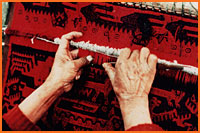
project entails the production and marketing of high quality weavings,
hand-crafted on traditional looms with natural wools; sheep and alpaca
wool in Jalq’a weavings and sheep wool and cotton in Tarabuco
weavings. In total there are 800 female weavers from the two
regions, organised in self-managed workshops located in rural
indigenous communities and peripheral neighbourhoods of Sucre, with
democratically chosen boards of directors.
The
chief success of this project is that it has been able to combine
economic growth with the development of a truly unique aesthetic
product. An estimated 50% to 60% of family cash income for
weavers now comes from weaving sales and although there is much more
weaving being done, the pieces of traditional dress have not been
degraded or “folklorised”. The intensity of textile work has
provoked, on the contrary, an acceleration of the processes of change
in the designs (processes always in existence), as part of a living
tradition. Weaving has motivated a much more passionate search of how
each region can express its own identity. The weavers have not tried to
adapt to the tastes of the buyers, and furthermore, are conscious that
what they offer is a world vision distinct from the observer’s own
experience. |
As
textile production constitutes a consistent and secure source of
monetary resources for bothtg men and women weavers, weaving has become
a fundamental activity, almost as important as agriculture. Without
trying to replace agriculture, the weavings have become an important
alternative, especially in times of climatic disaster.
The
objectives of the project are in no way closed: the future points to
expansion to other communities and a more diverse product line,
expansion into international markets, together with a deepening of
creative ethnic-cultural values.
The Jalq'a and
Tarabuco > |
Commercialization: ASUR's Store
The
Caseron de la Capellania, built in 1635 and declared national
patrimony, has been transferred to ASUR by the Governor of the
Department of Chuquisaca. In this colonial building, which has been
completely restored, ASUR has installed its retail store. Unlike other
handcraft shops, ASUR’s salesroom exhibits and sells only products made
by the indigenous villagers participating in the of Indigenous Art
Renaissance Program.
The profit from
the sale of these products not only offers weavers with the opportunity
to subsist on highly eroded lands with insecure agricultural yields but
also contributes to a weavers’ renewed feelings of pride toward their
textile tradition, to their ability to organise and administrate ASUR’s
workshops, as well as to an increasing appreciation of their own
culture. |
 The
term "handcrafts" is not the most appropriate for these products:
technically being of very high quality and artistically true works of
art, all conceived and produced within the local ethnic and cultural
tradition. Therefore, we prefer to refer to them as Indigenous Art. The
term "handcrafts" is not the most appropriate for these products:
technically being of very high quality and artistically true works of
art, all conceived and produced within the local ethnic and cultural
tradition. Therefore, we prefer to refer to them as Indigenous Art. |