On
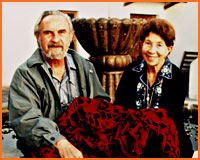
a crisp September morning in 1985, two anthropologists in their
mind-fifties, Spanish-born Gabriel Martinez and his Chilean wife
Veronica Cereceda, set out in their Jeep from Bolivia’s colonial
capital of Sucre on a quest to resolve a mystery that had long puzzled
them. Joined by Bolivian ethnologist Ramiro Molina, they were being
passed off as antiques in tourist shops in La Paz and other Bolivian
cities. Although the weavings were esteemed by collectors for
their uniqueness, and their fabulist designs were reproduced on
postcards, magazine covers, and posters and had inspired university
–trained painters in La Paz, surprisingly little was known about their
creators. Collectors and merchants referred to the weavings as “Potolo
pieces,” after the largest town (comprising some 600 families) in the
area of their origin, 50 kilometers northeast of Sucre. No ethnographic
studies of the culture or people responsible for the weavings could be
found.
For
several months, Martinez, Cereceda, and Molina combed the steep valleys
of Chuquisaca, visiting dozens of scattered communities by Jeep and on
foot. Much of what they found was disturbing but unsurprising.
The
area was inhabited by a group of nearly 25,000 people who called
themselves Jalq’a. They were severely impoverished; whit an infant
mortality rate on a par with Africa’s and average family incomes of $
100 per year.
Their parched potato fields and small flocks of
scrawny sheep and goats showed the effects of a longstanding drought.
Villages lacked clean water, electric power, and often health clinics;
and no tin roofs or bikes-common signs of minimal affluence among
Andean campesinos- were to be found. People seemed generally dispirited
and disorganized.
The three visitors were pleased to see that
most villages still wore traditional ethnic dress. But the aqsus worn
by the woman were pale reflections of the garments that had inspired
the team’s quest. The subtle color combinations were gone, the large
decorative panels called Pallas has shrunken in size, and the motif of
exotic animals in free fall had been replaced by repetitive rows of
stock figures. The adoption of geometric designs and colors used by a
neighboring ethnic group was gradually erasing the tenuous connections
to the past that remained. The young women, perhaps influenced by urban
values penetrating the countryside, had turned away from the exacting
standards maintained by their mothers and grandmothers.
Indeed, as Martinez and Cereceda talked with villagers, they began to
see that the decline in textiles was symptomatic of a deeper problem.
The
community’s cultural structure was unraveling from changes in the
regional economy. The drought had crippled subsistence production, and
rising demand among the jalq’a for noodles, candles, cooking oil,
medicines, and other consumer staples had increased the need for cash.
Beginning
in the 1960s and accelerating through the mid-1970s, a ready source for
that cash became available. A growing market for Andean textiles among
tourists and overseas dealers had spawned a horde of itinerant traders
who scoured the countryside for ponchos, shawls, aqsus, belts, bags,
and even grain sacks. Items whit Jalq’a motifs were in heavy demand,
and traders, some of them expatriates, frequented local fairs and
festivals to persuade campesinos, often through badgering or trickery,
to relinquish their finest textiles. The Jalq’a never learned the true
market value of these items, which steadily appreciated as they grew
rarer. One day the boom was over, and the Jalq’a awoke to find the core of
their weaving inheritance – their ritual costumes, wedding garments,
and family heirlooms – gone. Without models to inspire a new generation
of weavers, and the connection between weaving and ceremonial life
frayed, the Jalq’a tradition seemed virtually extinct, victim of the
same forces that had undermined indigenous textile arts throughout the
Andean during the second half of the twentieth century.
|
Yet
there was a bright spot. Martinez and Cereceda had received a small
grant from the IAF to explore the possibility of reviving weaving in
they visited a village, they sounded out the level of local interest.
The community of Irupampa was exuberant. After several visits by the
couple, a village leader confidently announced: “If you really want to
start a textile workshop in Chuquisaca put it here. Not only is the
community committed to this idea, but several of our women were once
highly skilled weavers and, given the chance, they will be again!”
It
helped that Martinez was fluent Quechua, the language spoken by the
Jalq’a, and that Cereceda was an internationally renowned authority on
Andean textiles, having been a curator for numerous museum exhibits and
written path breaking articles for scholarly publications. But their
greatest asset was also perhaps the most unlikely: a life of varied
experience that made them more interested in the Jalq’a as a people
than as artisans who could be trained to be economically productive.
To
facilitate the revival of Jalq’a weaving, Martinez and Cereceda started
a grassroots support organization (GSO) called Anthropologies del
Surandino (ASUR). ASUR, from its inception, was grounded in the belief
that economic development could not be isolated from its cultural
matrix. For a weaving workshop to thrive, it would have to be securely
rooted in the life of the community. The project in Irupampa was
therefore founded in close consultation with the local peasant
organization, and would proceed at a pace determined by its
participants.
The first task was not to train a few women for
commercial production, but to create a space in which the entire
community could explore the cultural roots that gave the Jalq’a their
identity and that had inspired the master weavings of the past.
Martinez, who had researched a book devoted to unraveling the meanings
of a widespread Andean ritual known as “The burning of the tables,”
believed that little could be accomplished until the Jalq’a had made
the project their own.
The first workshop was constructed with
community labor; several experienced women weavers whom Cereceda and
Martinez had met during their travels in Chuquisaca were recruited as
teachers; and IAF funding was used to stockpile alpaca and sheep wool
for spinning yarns. Everyone was anxious to begin, but one hurdle
seemed insurmountable. The women still knew how to weave, but they did
not recall the many strange animals, called khurus, that had been the
hallmark of Jalq’a designs. Many of these were reputed to have
originated in the dreams of ancestors, or from cave drawings lost in
antiquity. Without a stock of traditional textiles to guide them, the
Jalq’a seemed unlikely to ever recreate the khurus, much less shape
their world of chaotic free fall into a semblance of order.
Cereceda’s
solution was to contact to collectors and dealers she knew in Bolivia
and overseas, to get photographs of the Jalq’a weavings they owned.
Soon a photographic archive of more than 300 traditional motifs was
assembled. Enlargements were printed and mounted on the workshop walls
to guide teenage apprentices; others were hung in the patios of
households so that mothers and their daughters could use them as models
for their weaving. Eventually, photo albums and slide shows were
assembled to circulate in communities outside Irupampa as word spread
of the textile revival that was under away.
Cereceda still
recalls the enthusiasm among the Jalq’a women when they first glimpsed
the photos. She explains that it was not a question of anticipating the
imminence of monetary reward. Nothing had yet been woven, and there was
no assurance anything would be sold. Rather it was like a lost child
returning home. The photographs allowed the women to bring khurus that
had been forgotten back to life and figure out how they fit together in
a world of unexpectedly rich colors.
Finally, Cereceda decided
that it was time to inform the outside world of what had been
accomplished. Having curated exhibits of Andean weavings in both Chile
and France, she decided to do so again in Bolivia. ASUR collected the
best of the new textile and arranged to showcase them inside a public
building in Sucre that had once been a Catholic church.
|