The Indigenous Textile Art Renaissance Program
The
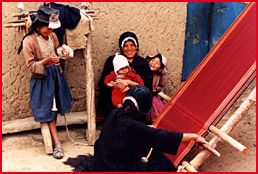
Indigenous Textile Art Renaissance Program began in 1986. Its objective
has been to revive the quality and symbolic design motifs in danger of
extinction, which have characterized the traditional textiles from the
South-central regions of Bolivia for centuries. Above all, it is an
attempt to generate income for some of the poorest rural families
through the marketing of textile products.
|
|
|
Production Project Specialized for Male Weavers (Since 1996)
For
several years now, 200 male weavers, organized in 12 community
production units, have been weaving new products from fine alpaca wool
resulting in an diversification in their community’s textile production
while reviving pre-Hispanic weaving techniques, embroidery and natural
dyes. These new products include: "gobelinos" (pre-Columbian
tapestries), shawls of fine naturally dyed cloth, traditional Andean
embroidery, and rugs.
This project has been instrumental in forming new artistic roles for many of the men who had lost this part of their tradition.
|
In
2003 the Indigenous Textile Art Renaissance Program began a new form of
diversification, combining fine llama leatherwork with textile
inlays. The novelty of this production, compared to similar
products in Bolivia and Peru, is that the textiles are sized and shaped
specifically for each piece (purses, wallets, spectacle holders,
notebooks), while conserving their characteristic quality and
authenticity.


|
|
Export Training and Production Project (2002)
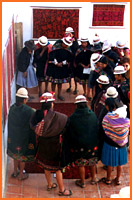
During
2002, 240 male and female weavers were trained to deal with export
market orders, everything from exact sizes to premium quality to
on-time completion standards. Together with technical
preparation, weavers received business administration and credit
management training.
|
 |
Central Ceramics Workshop
(Since 1994)
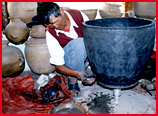
ASUR’s
Ceramics Workshop, situated in the Munay Pata neighbourhood of Sucre,
is fulfilling its principal objectives: production of fine pottery of
high technical and aesthetic quality, investigative work, and the
testing of traditional pottery techniques, materials and tools.
Currently, production is centered upon kitchen and tabletop, as well as
decorative products all decorated with skilfully executed Jalq’a
motifs. This project is currently under renovation. |
|