| ASUR
> Institucional Profile | Permanent Projects | History |
 |
|
|
|
Projects
> Training Activities | Recent Projects |
|
| In
all of the projects previously mentioned, as for the more recent ones
mentioned below, a strong emphasis is always placed on training and
education. These components are always an integral part of ASUR’s
activities and have contributed to achieving the project’s considerable
production goals. |
|
|
|
| |
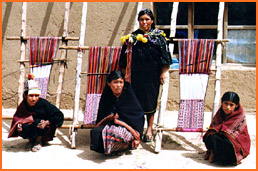
Training of master female weavers
(1996, 1997 and
2001)
The
intention was to develop very highly skilled female weavers so that
they are not only able to produce distinguished works but also able to
teach new generations and act as guides within their workshops.
These groups of “chosen ones” (or “aqllas” in Quechua) are now 100
members strong. They are employed within their organizations to
control quality and also work as teachers, not just in technical areas,
but with all the cultural aspects dealing with design creation.
|
 |
| |
|
| |
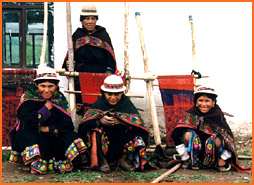
Training of young women weavers
(1993, 1995, 1997 and 2000) Each
workshop is responsible for choosing its teachers and recruiting enough
girls to meet the 3-to-1 student-professor ratio. Courses are
either yearlong programs held every Saturday or intensive programs
during school vacation and have resulted today in a whole new
generation of young weavers. Those constitute the strength of the
Indigenous Art Renaissance Program.
The young women hold their
own exhibitions, aid in cultural recuperation, and assist with workshop
administration. Girls between the ages of 10 to 15 participate.
|
|
|
|
| |
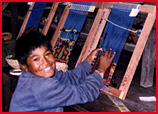
Training of young men weavers
(Initiated in 1997 and continued periodically afterwards)
Young
men have been trained in their local workshops, either through courses
or by serving as apprentices to a local master weaver. It has often
been the experience that boys are often the most eager to learn new
trades when the opportunity arises. ASUR’s primary objective is to
train men, especially those who are married, so that they will be able
to remain in their communities, nevertheless, sons find ways to “go in
place of their fathers” and so also receive training to weave
tapestries and especially fine cloth. Young men receive vocational
training from adults who have already mastered their trade. They are
particularly drawn to the pre-Columbian tapestry technique revitalized
by ASUR, where there is ample space for creativity expression through
the creation of unique figures. More recently, young men are also
learning how to make carpets and fine cloths. |
For
both young men and women, weaving is done voluntarily during free time
and represents an important source of income towards their school
tuition, while also giving them the confidence of mastering a trade.
|
| |
|
| |
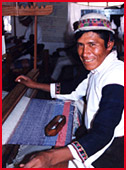
Training of men in various trades
(Since 1995)
Given
men’s pressure to participate in the textile project, ASUR sought out
products and techniques that would not compete with those of the
women. Men weave in separate workshops where master weavers from
other countries were brought to Bolivia to teach forgotten
pre-Columbian techniques (tapestries, embroideries, and brocades) and
where instructors from inside Bolivia also taught weaving and carpet
making techniques. Students, taught by foreign experts, later
take charge of teaching other students, including those in other
communities and other regions of Bolivia. Through this system,
200 men have received professional training, and many of them are ready
now to teach others. (Male weaver groups are organized in 13
independent production workshops). |
|
|
|
| |
Men and women weavers trained to produce small weaving inlays for leatherwork
Two
hundred and forty of the best female and male weavers were selected for
training to produce small weavings of precise sizes, appropriately
designed to be later incorporated into different alpaca and llama
leather products. Male and female weavers have had to adapt to this new
format regarding size and perspective. This has led to the design of
new looms which permit the exact measuring of the weaving as well as
production in small scale. |


|
| |
|
| |
Training of leaders in accounting, administration, and management
This
has been a continuous activity over the years given the periodic
renewal of the board of directors that have learned these skills in
each workshop.
|

|
|
|
| |
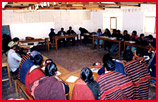
Courses on Indigenous Rights
( 2001, 2002 and 2003)
Courses
have been designed to educate villagers about laws and rights affecting
rural communities, and to teach them about Bolivian governmental
structures conducted in association with Central Unica Departamental de
Trabajadores Campesinos (a rural workers organization). |
The courses are open to whole communities, not just those working in the weaving workshops.
|
|
|
| |
Courses on Ethno-tourism
( 2001, 2002 and 2003)
These
courses were offered in the communities of Maragua, Potolo, and
Chaunaca in order to teach villagers how to welcome tourists, organize
services, learn about the surrounding ecology, and take care of the
natural environment in which they live. Villagers formed
Community Tourism Committees with respective rules and official legal
status. |
Training in Community Museums
(Seminars in 2001 and 2002)
Workshops
and seminars with local representatives from many rural areas, have
sought to train people to start their own community-based museums. |
| |
|
| home
| asur | museum
| shop | textiles
| contact |