| ASUR
> Institutional Profile | Projects
| Permanent Projects
| History |
 |
|
|
|
Projects
> Training activities | Recent Projects
|
|
Project “Association of Indigenous Textile Art Producers” and its internal structures
This
project involves identifying the best ways to create an organization
which brings together all of the textile workshops. In 2000, The
Male and Female Weaver’s Association “Inca Pallay” was legally
instituted. |
|
|
|
| |
Strategic Plan for Ethno-Eco Tourism in the Jalq'a Area of Disctrict 8 of the Municipality of Sucre This
project forms part of an ethno-eco tourism program in the Jalq’a
indigenous communities of District 8 of the Municipality of Sucre. It
is the first step towards developing a sustainable tourism project that
will be managed and executed by the communities themselves and oriented
to their culture. It is a pioneering project in the Department of
Chuquisaca and the region.
The ethno-eco tourism project
intends, in addition to programming and regulating visits by tourists,
to revitalise cultural expressions as the principal product offered.
There will not only be spectacles such as dances, musical performances
and festivals, but also aspects of the culture that are less visible
such as agricultural techniques, beliefs about the working of nature,
knowledge of natural herbs and dyes – and everything that forms the
basis of life in their community.
|
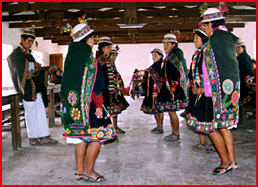
As
a first step, with the help of UNDP (United Nations Development
Program) a Tourist Information Centre was constructed in the village of
Chaunaca, and was designed to blend with the local architecture.
This centre was opened in March 2004 and is run by the area’s
participating communities.
Three community projects from this
district have been approved for financing by “Proyectos
LIL/indígena; these include the startup of community museums and
tourism welcome centers situated in traditional Jalq’a communities.
|
| |
|
| |
Project:
Cultural Recovery and Dispersion Conceiving
culture as an integral fact giving meaning to all activities within a
cultural group, this project proposes, firstly, to rescue cultural
expressions in danger of being forgotten, as well as encouraging the
birth of new forms of cultural expression. Subsequently these rescued
materials (notes, photos, various documents) will be given to
communities for their memory and reflection, while at the same time
diffusing them in urban areas to create a better understanding of
traditional cultures.
This project has obtained the
significant involvement of the municipalities in which the Tarabuco and
Jalq'a communities are located. This corresponds whit their growing
interest in promoting cultural festivals and ethno-tourism projects.
|
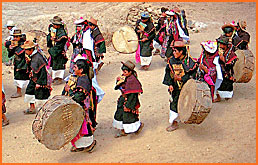
One
result of this project to date has been the formation of eight
traditional dance and music groups, who now have meeting and storage
spaces for their instruments and have established guidelines and fees
for both urban and rural performances. |
|
|
| |
Project: Indigenous Rights The
Indigenous Rights Project aims to ensure that the Jalq'a and Tarabuco
ethnic groups have sufficient information, knowledge and tools to
defend and exercise their rights as indigenous groups.
This
project was envisioned stemming from diagnostic studies in two areas;
one oriented to the recovery and compilation of all existing
legislation concerning indigenous rights, and the other to ascertain
the level of information, knowledge and exercise of rights, legislative
or not, present in the communities.
|
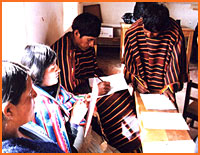
This
project is undertaken in cooperation with the subcentralias (the
governing syndicate for the Canton) and has awoken a great interest
among the rural population. It has carried out numerous courses and
seminars in 2001, 2002 and 2003. |
| |
|
| |
Expansion of the Indigenous Art Renaissance Program to Potosi
This
project began in 2004 in order to revitalize textile arts in two large
ayllus in the Department of Potosi: Calcha and Tinkipaya. The
project involves more than 400 weavers, advising them in different
technical aspects, as well as design. Through handcraft production and
marketing, alternative options for sustainable development are created
in this extremely impoverished and ecologically fragile area that, at
once, foments criteria supporting economic development while valuing
local culture.
|
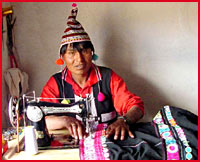
Two
new stores located in the city of Potosi and in the town of Uyuni, and
a display room in the Sucre museum, allow for the marketing of these
products. |
| |
|
| |
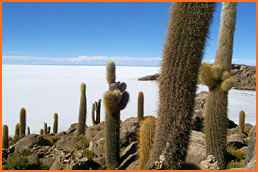
Responsible Tourism on the Potosi - Salar de Uyuni Route
Together
with Cooperacion Italiana (COSV), ASUR has begun an ethno-tourism
project in the area of the Uyuni salt flats. This innovative initiative
strives to improve the quality of life in interested communities while
developing responsible tourism, which is participatory and sustainable,
and to stimulate the culture in these traditional villages integrating
it eventually into their tourism offering. Having communities
become more actively involved in their own tourism development is
another objective, as is protecting the indigenous flora and fauna. |
|
| |
|
| home
| asur | museum
| shop | textiles
| contact |